
Twin-screw positive displacement pumps
Warren has built twin-screw pumps for difficult fluids for over 100 years. Screw pitch and profile can be varied in manufacture, so each pump can be matched to its duty.
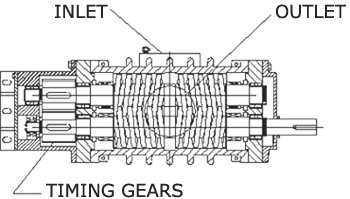
How a double-ended screw pump works
Fluid entering the inlet is split into two equal streams, one for each end of the screws. As the screws intermesh they form sealed transfer chambers that carry the fluid along the rotor to the discharge in the centre. The two sets of screws push against each other, so the rotor is hydraulically balanced.
What it handles
Liquids containing abrasive solids or gas, non-lubricating fluids, crude, asphalt, polymers and fuel oils. Shear rates are low, so the product is not degraded on its way through.
Pick a series
Low pressure: Houttuin 100 to 300 series. Medium pressure: GTS 2100. High pressure: FSXA 2300. Heavy and viscous: Jaguar 2200. Barges: J-70 2201. Pulp stock: High Density 2601.
- Flow
- 5-5,000 gpm
- Pressure
- 0-1,450 psid
- Temperature
- 0-750 °F
- Viscosity
- 0.2-2,000,000 cSt
Common questions
What flow and pressure range do Warren twin-screw pumps cover?
From 5 to 5,000 gpm (1 to 1,150 m³/h) and from 0 to 1,450 psid (0 to 100 bar), for fluids from 0.2 to 2,000,000 cSt and 0 to 750 °F.
Can a twin-screw pump handle fluids with gas or solids?
Yes. Warren twin-screw pumps are built to handle liquids containing abrasive solids and gas, with a wide choice of materials and mechanical seals.
Which series is right for my application?
Start from pressure: Houttuin for low pressure, GTS 2100 for medium, FSXA 2300 for high pressure crude and fuel service. Call (413) 436-7711 or send the duty and we will match the series.
Get a quote: Twin-screw pumps
Prefer to talk? Call (413) 436-7711.
- The duty: fluid, viscosity and temperature.
- Flow and pressure you need, and suction conditions.
- For repairs: pump series and serial number.